The Behistun Monument
The Behistun Monument of Iran is Important to Our Understanding of Israel in the Persian Period
In x Parts
The Behistun Monument in Iran is of great importance to our understanding of the time period involving the ministries of Ezra and Nehemiah
Ezra chapter four gives us the account of the beginnings of the Samaritan opposition to the building project of the returned captives of Judah. When the Samaritans, also referred to as "the people of the land" in verse four, first noticed the Judeans preparing to build the temple, they came to offer their assistance.
1 Now when the adversaries of Judah and Benjamin heard that the children of the captivity builded the temple unto the Lord God of Israel;
2 Then they came to Zerubbabel, and to the chief of the fathers, and said unto them, Let us build with you: for we seek your God, as ye do; and we do sacrifice unto him since the days of Esarhaddon king of Assur, which brought us up hither.
However, the chief fathers of Judah immediately rejected their offer, saying,
Ye have nothing to do with us to build an house unto our God; but we ourselves together will build unto the Lord God of Israel, as king Cyrus the king of Persia hath commanded us.
Make note who is credited with giving the command to rebuild. It is none other than Cyrus, King of Persia. Immediately, the true resolve of the Samaritans came to light.
4 Then the people of the land weakened the hands of the people of Judah, and troubled them in building,
5 And hired counsellors against them, to frustrate their purpose, all the days of Cyrus king of Persia, even until the reign of Darius king of Persia.
After the death of Cyrus, Cambyses his son, ascended the throne. As part of the Samaritan campaign against the Jews, to "frustrate their purpose,” they engaged in a letter writing campaign. They wrote to Cambyses, referred to in verse six as Ahasuerus. This apparently got no results, so after eight more years, when another king took the throne, they wrote to him. He is referred to as Artaxerxes in verse seven. As noted earlier, both of these names, Ahasuerus and Artaxerxes, are titles adopted by the kings of Persia, not their actual names. So do we know what their real names were?
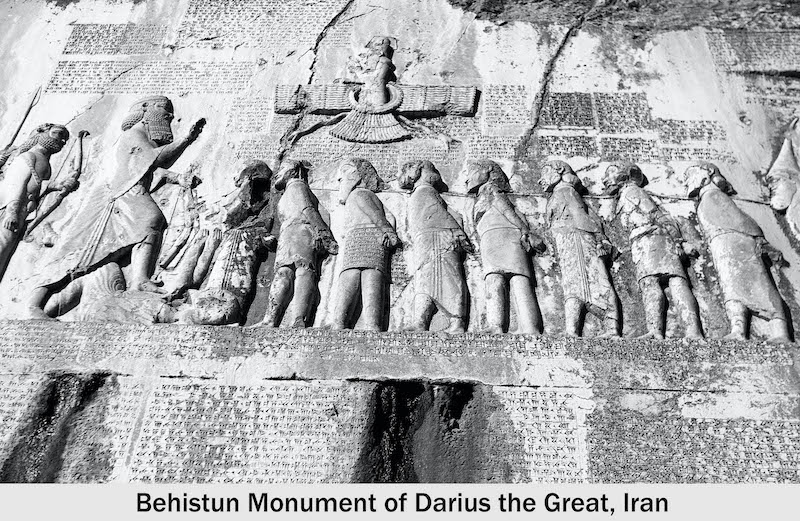 Yes, we do. This is where the Behistun Inscription comes to our aid. (See image to left)
The Behistun Inscription or Monument "is a multilingual inscription and large rock relief on a cliff at Mount Behistun in the Kermanshah Province of Iran, near the city of Kermanshah in western Iran." (Wikipedia) The inscription is written in three ancient languages, Old Persian, Elamite and Babylonian.
Yes, we do. This is where the Behistun Inscription comes to our aid. (See image to left)
The Behistun Inscription or Monument "is a multilingual inscription and large rock relief on a cliff at Mount Behistun in the Kermanshah Province of Iran, near the city of Kermanshah in western Iran." (Wikipedia) The inscription is written in three ancient languages, Old Persian, Elamite and Babylonian.
There is a goodly amount of historical information pertaining to the life and times of Darius the Great, the king of Persia (aka, Darius Hystaspes). Much of this information comes from this inscription. Contained within the inscription is the names of these two kings in Ezra chapter four, which are mentioned only by their titles (Ahasuerus, Artaxerxes) .
As it states in Ezra 4:5, the enemies of Judah attempted to frustrate the building process beginning in the days of Cyrus. They knew that it would do no good to write a letter to Cyrus, requesting that he halt the building process in Judah. Cyrus seemed extremely adamant about the whole idea. So they would need to wait until another king took the throne. This happen after Cyrus died and his son, Cambyses, took over. Cambyses is the Ahasuerus referred to in Ezra 4:6. Also, as stated earlier, Cambyses was likely committed to carrying on the policies of his father. So when the Samaritan letter reached him, if it ever really did, it fell on deaf ears. Whatever Cambyses' attitude toward the rebuilding in Judah might have been, no response is recorded. The inscription informs us of this period regarding Cambyses and Pseudo-Smerdis. The words in brackets [ ] are the original Old Persian names.
(10) King Darius says: The following is what was done by me after I became king. A son of Cyrus [Kûruš], named Cambyses [Kabûjiya], one of our dynasty, was king here before me. That Cambyses had a brother, Smerdis [Bardiya] by name, of the same mother and the same father as Cambyses. Afterwards, Cambyses slew this Smerdis. When Cambyses slew Smerdis, it was not known unto the people that Smerdis was slain. Thereupon Cambyses went to Egypt. When Cambyses had departed into Egypt, the people became hostile, and the lie multiplied in the land, even in Persia and Media, and in the other provinces.
(11) King Darius says: Afterwards, there was a certain man, a Magian [maguš], Gaumâta by name, who raised a rebellion in Paishiyauvada, in a mountain called Arakadriš. On the fourteenth day of the month Viyaxana (11 March) did he rebel. He lied to the people, saying: 'I am Smerdis, the son of Cyrus, the brother of Cambyses.' Then were all the people in revolt, and from Cambyses they went over unto him, both Persia and Media, and the other provinces. He seized the kingdom; on the ninth day of the month Garmapada (1 July) he seized the kingdom. Afterwards, Cambyses died of natural causes.
(12) King Darius says: The kingdom of which Gaumâta, the Magian, dispossessed Cambyses, had always belonged to our dynasty. After that Gaumâta, the Magian, had dispossessed Cambyses of Persia and Media, and of the other provinces, he did according to his will. He became king.
Unknown to the kingdom at large, Cambyses had killed his brother, Smerdis. With Cambyses away on a military campaign in Egypt, it gave opportunity for intrigue. A magi named Gaumata pretended to be Smerdis, the son of Cyrus, brother of Cambyses. He knew that Smerdis was dead, but he also knew that this was not public knowledge. It has been said that he actually favored Smerdis in looks, at least from a distance. Gaumata was able to gain power with the help of his own brother, Patizithes, who was also a magi.
According to Herodotus, Patizithes was the real power behind the throne. Apparently, Gaumata (also referred to as Pseudo-Smerdis, or False Smerdis) was just the front man for his brother ("The royal power was possessed by the Magi Patizithes and his brother" [Herodotus iii, 65]).
The people feared this false Smerdis. He killed anyone who had previously known the real Smerdis.
"The people feared him exceedingly, for he slew many who had known the real Smerdis. For this reason did he slay them, 'that they may not know that I am not Smerdis, the son of Cyrus.' There was none who dared to act against Gaumâta, the Magian, until I came.” (Behistun)
After less than three months in power, Darius came and killed Gaumata and his brother, Patizithes, regaining the throne for his family and himself.
According to the dates given in the inscription, Gaumata began his revolt in mid-March. He took actual possession of the throne on July 1, and reigned until he was killed by Darius Hystaspes on September 29. This means his total time of seeking the rule of Persia, lasted for seven months (from March to September). However, he was only the recognized king of Persia for three months (July, August, and September). This is of course, according to the witness of Darius, via the Behistun Inscription.
Darius spent the next couple of years putting down rebellions that had sprung up all over the Persian Empire. This makes the response of Darius to the Samaritans request all the more fantastic. The Samaritans wrote Darius a letter to see if he could confirm that the Jews did indeed have permission to build Jerusalem and the temple, or were instigating rebellion. If Darius had any suspicion of an uprising from the Jews, this would have been an excellent chance for him to put a stop to it.
Darius had a search done of the records and found that indeed Cyrus had given such permission. He not only gave permission to rebuild Jerusalem and its temple, but he set the dimensions for it [Ezra 6:3-5].
In Summation, the Behistun Inscription of Darius Hystapses helps us to fill in the gap between Cyrus and himself. This gap is the same period of time that the returned captives of Judah were facing intense opposition from the Samaritans. This among others yet to come, was the "troublous times" spoken of in Daniel's Seventy Weeks prophecy.
